Guides / Reset what you already have
A Small-Pantry Reset That Does Not Require Buying New Containers
This guide is for a pantry, food cabinet, or kitchen shelf that contains useful food but has become difficult to understand or maintain. It does not require decanting, matching containers, a large empty counter, or a one-day makeover.
What a reset is supposed to fix
A reset is not a cleaning performance. It is a short investigation into why the space keeps becoming difficult.
Common failures include:
- frequent food is behind occasional food;
- active packages and unopened duplicates compete for the same position;
- one category spreads because it has no visible boundary;
- packages enter the cabinet wherever a gap appears;
- the back of a deep shelf has no retrieval path; or
- food that belongs elsewhere has accumulated in the pantry.
Buying containers before identifying the failure can preserve the same problem inside neater boxes. Start by changing the arrangement. A product becomes useful only when the test reveals a missing function such as pull-forward movement, stable added height, division, or controlled stacking.
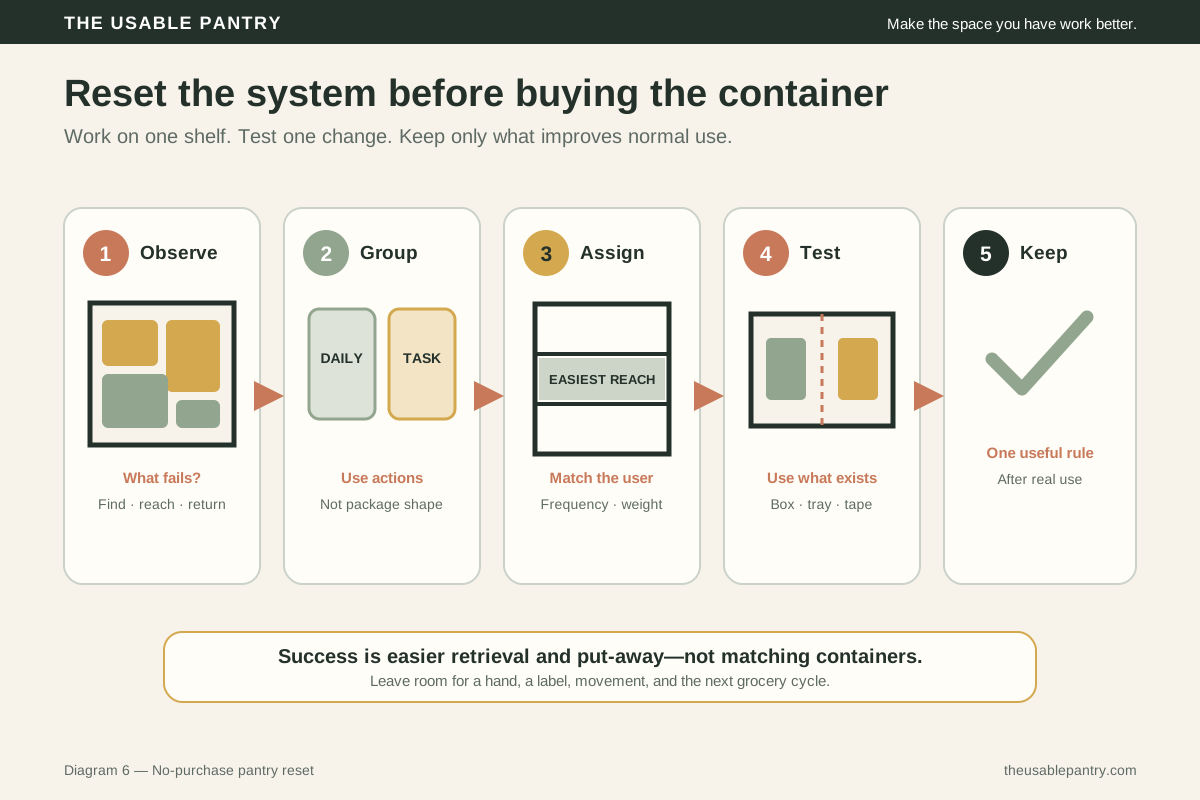 Open diagram full size
 Before moving anything, capture the starting condition
Work on one shelf or small zone. Take a straight-on photo for your own reference after removing private details. Then answer three questions:
- Which item is hardest to find or retrieve?
- Which category is hardest to put away after shopping?
- Which food is bought again because nobody can see the existing supply?
These answers define the test. “Make it look better” is too vague to tell you whether the reset worked.
Check package storage directions before treating an item as pantry food. FDA advises consumers to follow storage directions on labels, and USDA notes that some packaged or canned products still carry a “Keep Refrigerated” instruction. See FDA food-storage guidance and USDA shelf-stable food guidance.
The one-shelf reset
Step 1: Remove and sort by destination
Take everything from one shelf. Make four temporary groups:
- returns to this shelf;
- belongs elsewhere;
- active package plus intentional refill;
- needs a storage or quality decision.
Do not interpret every printed date as a universal safety deadline. Date-label phrases can describe quality rather than safety, with important food-specific exceptions. Use the package instructions and a food-specific source such as the federal FoodKeeper resource.
Step 2: Group by the next action
Group the returning food according to how the household uses it: breakfast, weeknight cooking, baking, lunch packing, snacks, or controlled reserve. An action group often reduces repeated searching better than arranging solely by package shape.
Keep labels and storage instructions readable. If the household depends on ingredient or allergen information, preserve the original package or another reliable way to retain that information.
Step 3: Assign the easiest useful positions
Place the most frequent action at the easiest reach for its actual user. Put regular categories beside it. Use a less convenient position for occasional or reserve food only when the contents remain identifiable and retrievable.
Heavy, fragile, tall, or awkward items can override frequency. “Used every day” does not automatically make an overhead position safe or controllable.
Step 4: Create temporary boundaries
Use what is already available:
- an open cardboard box as a pull-forward lane;
- a clean tray as a category footprint;
- removable tape at the shelf edge;
- a paper label;
- an existing container without a lid; or
- a fixed left/right shelf position.
Temporary materials test layout and movement. They do not prove long-term load, cleanability, moisture resistance, food-contact suitability, or durability.
Step 5: Leave working room
Do not refill every gap. A shelf needs room for a hand, a visible label, the movement of a lane or package, and normal variation after shopping. Empty space can be operating space rather than wasted capacity.
Choose the test by the failure
| What keeps going wrong | First no-purchase test | Useful signal | Stop or change the test when |
|---|---|---|---|
| Food disappears at the back | Put one category in a long existing box | The whole category comes forward in one movement | The loaded box becomes heavy or catches |
| New groceries have no address | Mark category widths with removable tape | Put-away decisions become obvious | The boundary is too small for normal demand |
| Daily food competes with duplicates | Separate active and controlled reserve | The active item stays visible | Nobody checks reserve before shopping |
| Short packages hide behind tall ones | Move short items forward or test stable elevation | Labels remain visible and reachable | Visibility improves but reach does not |
| Categories keep mixing | Group by repeated action and add a paper label | Household members return items consistently | The group is too broad or unfamiliar |
| The shelf is simply overfilled | Reduce duplicates or relocate rare items | Working room remains after a grocery cycle | Necessary stock has no safe alternative home |
Worked example: reset a 64 cm shelf
Live with the test before shopping
Use the temporary layout through a normal week or grocery cycle when practical. Notice:
- which food migrates;
- which boundary overflows;
- whether a full box becomes difficult to pull;
- whether labels remain visible;
- whether anyone returns an item to the wrong group; and
- whether the arrangement reduces duplicate buying.
Change the smallest failed rule. Do not restart the entire pantry every time one category behaves differently than expected.
Common reset mistakes
- Emptying the entire kitchen and losing the ability to test one clear change.
- Buying containers because the temporary shelf looks unfinished.
- Removing original labels without preserving needed information.
- Giving every category a separate container even when a position is enough.
- Treating reserve stock as unlimited overflow.
- Filling the new arrangement to maximum capacity.
- Photographing a staged result but never testing normal put-away.
Frequently asked questions
Do I have to throw food away to reset the pantry?
No. Make storage and quality decisions using the package, food-specific guidance, and household needs. The reset can relocate, group, or intentionally use food without treating appearance or a generic date rule as disposal advice.
Can cardboard boxes stay permanently?
They can test a category footprint and movement. Whether they are suitable for continued use depends on moisture, pests, loading, cleaning, package contact, and the environment. Replace them only if the function works and the temporary material is the remaining problem.
How often should I reset the pantry?
Use small triggers: when a zone repeatedly overflows, put-away becomes unclear, or food disappears again. A short boundary adjustment is usually better than a scheduled total makeover.
What if other household members ignore the layout?
Make the address simpler. Use fewer, more familiar action groups, clearer front labels, or a larger realistic boundary. A system that requires one person to explain every item is too complicated.
Methodology and evidence
Continue from the reset
Measure any successful temporary footprint before replacing it. Use How to Measure a Pantry Before Buying Organizers and the free measurement worksheet.
Found a reset case this framework misses? Send a correction.