Guides / Plan a high shelf
How to Use High Pantry Shelves When You Cannot Reach the Back
High-shelf capacity is not the same as usable capacity. A package can fit physically while remaining invisible, uncontrollable, or dependent on unsafe reaching.
Define usable reach honestly
For the intended user, ask whether they can:
- identify the category from the normal position;
- reach the handle or front edge without overreaching;
- control the realistic loaded weight;
- lower it without unseen items falling; and
- return it without pushing it into a forgotten back zone.
If any step fails, change the location, category, load, or access method. Do not average several household members into one imaginary user.
 Open diagram full size
 What belongs on a high shelf
A high position may suit a light, occasional, or intentionally counted category when the user has an appropriate way to retrieve it. Examples might include light paper goods, empty reusable containers, or a small labeled reserve of suitable shelf-stable food.
Avoid assigning a high shelf merely because an item is infrequent. Weight, fragility, leakage, package condition, child or household constraints, and the actual access method can override frequency.
Check package storage directions. High areas near appliances, ceilings, or other heat sources are not automatically suitable for food. USDA advises storing canned goods in a cool, clean, dry place away from temperature extremes; see USDA shelf-stable food guidance.
Give the back one controlled movement
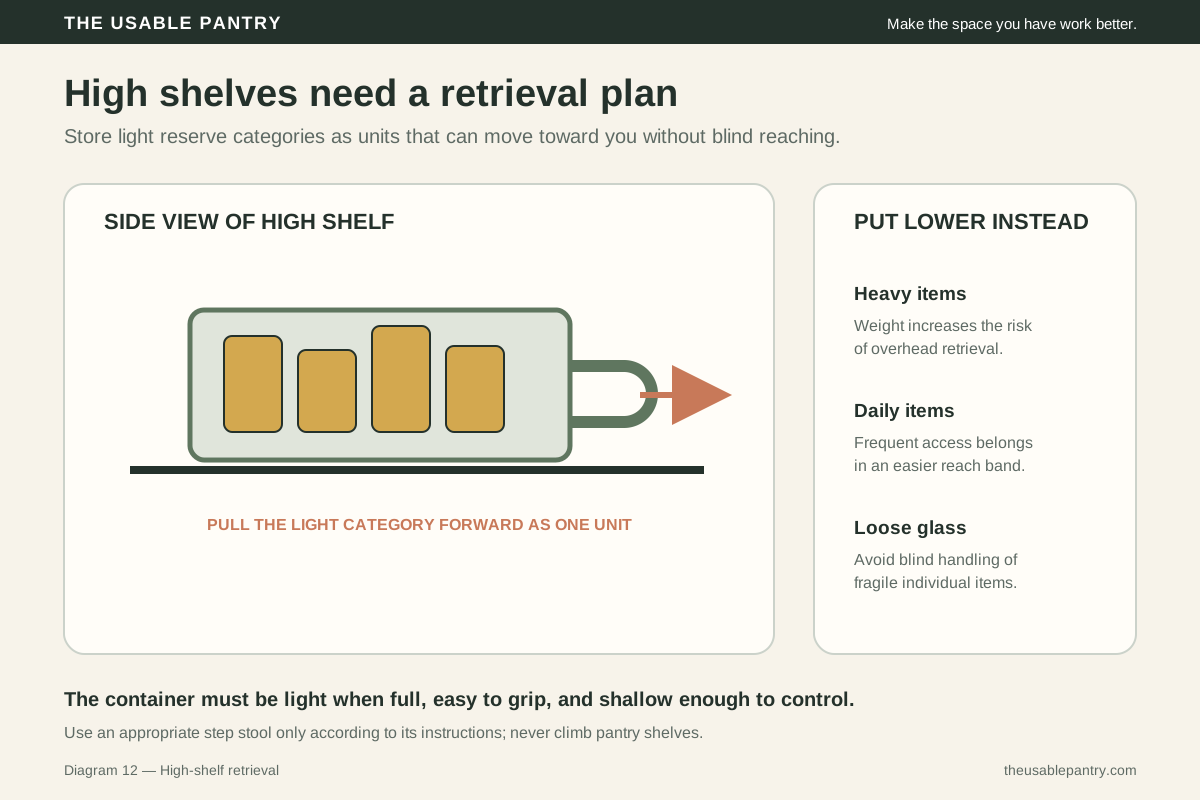
Loose packages at the back create several uncertain movements. Instead, test one narrow category that comes forward as a unit and remains within a known load.
The container is not the solution by itself. The full system needs:
- a large readable front label;
- a handle or grip the intended user can control;
- a load limit stricter than the container's available volume when necessary;
- clearance from the shelf above, lip, door, and frame;
- no loose item resting on top; and
- a rule preventing the category from expanding into the unreachable back.
Choose a strategy by the failure
| High-shelf failure | First arrangement to test | Why it may help | When the space is not usable for that item |
|---|---|---|---|
| Light reserve packages disappear | One labeled, counted pull-forward category | Identity and quantity move together | Loaded category cannot be controlled |
| Several loose items fall forward | Reduce to one bounded category near the front | Removes hidden unstable layers | Items remain fragile, heavy, or awkward |
| Shelf is too deep to see | Keep the back empty or assign one recorded reserve | Prevents random overflow | Retrieval still requires blind reaching |
| Daily item is stored overhead | Move it to easier reach | Reduces repeated access effort | No safe, practical repeated method exists |
| User needs elevation to reach | Use only an appropriate product and method for that user and setting | Creates a deliberate access position | Product condition, setup, or user control is uncertain |
| Large light object blocks the view | Test a smaller category footprint or different shelf | Restores identification and grip | Object cannot pass the opening or be lowered safely |
Measure the high-shelf route
Record the narrowest opening, shelf width, usable depth, smallest clear height, front lip, door clearance, and the vertical space needed to lift or tilt the category. Then record the intended grip point and maximum household load.
Measure from the user's access position, not only from floor level on a diagram. If an access product is involved, follow its instructions, inspect it, place it as directed, and verify that the surrounding space permits correct use.
CPSC maintains current ladder recall information, including fall and collapse hazards. OSHA's portable ladder safety card is workplace guidance rather than household-specific instruction, but its warnings reinforce that appropriate selection, inspection, stable setup, and avoiding overreaching matter. Product instructions and the user's circumstances control the actual decision.
Worked example: limit a light reserve category
A floor-level mock-up before using the shelf
Test the category at a comfortable height first. Load an existing box with the real intended contents, label it, and practice gripping and controlling it. Measure its greatest exterior dimensions and realistic weight using an appropriate household method.
This can reveal a category that is too broad or heavy before anyone attempts overhead retrieval. It cannot prove that a high-shelf movement or access product is safe for a specific user.
Common mistakes
- Treating the least visible space as automatic reserve storage.
- Putting daily food overhead because it fits.
- Filling a large basket until its weight defeats the handle.
- Using a tiny or hidden label that cannot be read from below.
- Stacking loose objects on top of the pull-forward category.
- Ignoring heat, moisture, or package storage directions.
- Reaching from furniture or another improvised surface.
- Planning for the tallest household member when others use the pantry.
Frequently asked questions
Should the top shelf stay empty?
It can. Empty inaccessible space is not a failure. Use the shelf only when a specific light category and retrieval method make it genuinely usable.
Are clear bins better up high?
The user may see only the bottom, not the contents through the side. Test the real viewing angle. A large front label may communicate more than transparency.
Can a grabber tool solve the back of the shelf?
Only if the specific tool, item, user, load, grip, and return movement are appropriate and controlled. This guide does not assess assistive equipment. Avoid a method that can puncture, crush, drop, or misplace the package.
What if only one person can reach the shelf?
Make ownership and responsibility explicit, and do not place shared frequent food there if other intended users cannot access it. Household systems should match their actual users.
Methodology and evidence
Continue from the high shelf
Use How to Divide a Small Pantry Into Practical Storage Zones to move frequent and heavy categories to more controllable positions.
Found a high-shelf access case this guide misses? Send a correction.