Guides / Choose vertical access
Shelf Risers vs. Stackable Drawers: Choose by Access, Not Appearance
Both products use vertical space, but they solve different failures. Choosing between them by style or advertised capacity can create a shelf that holds more while becoming harder to use.
Diagnose the missing movement
Watch what a user must do to retrieve one target item.
- If a front row hides a short back row, visibility may be the main problem.
- If packages are visible but several must be moved, retrieval is the problem.
- If a category spreads and collapses, containment may be the problem.
- If the shelf is already easy to use, unused height may not be a problem at all.
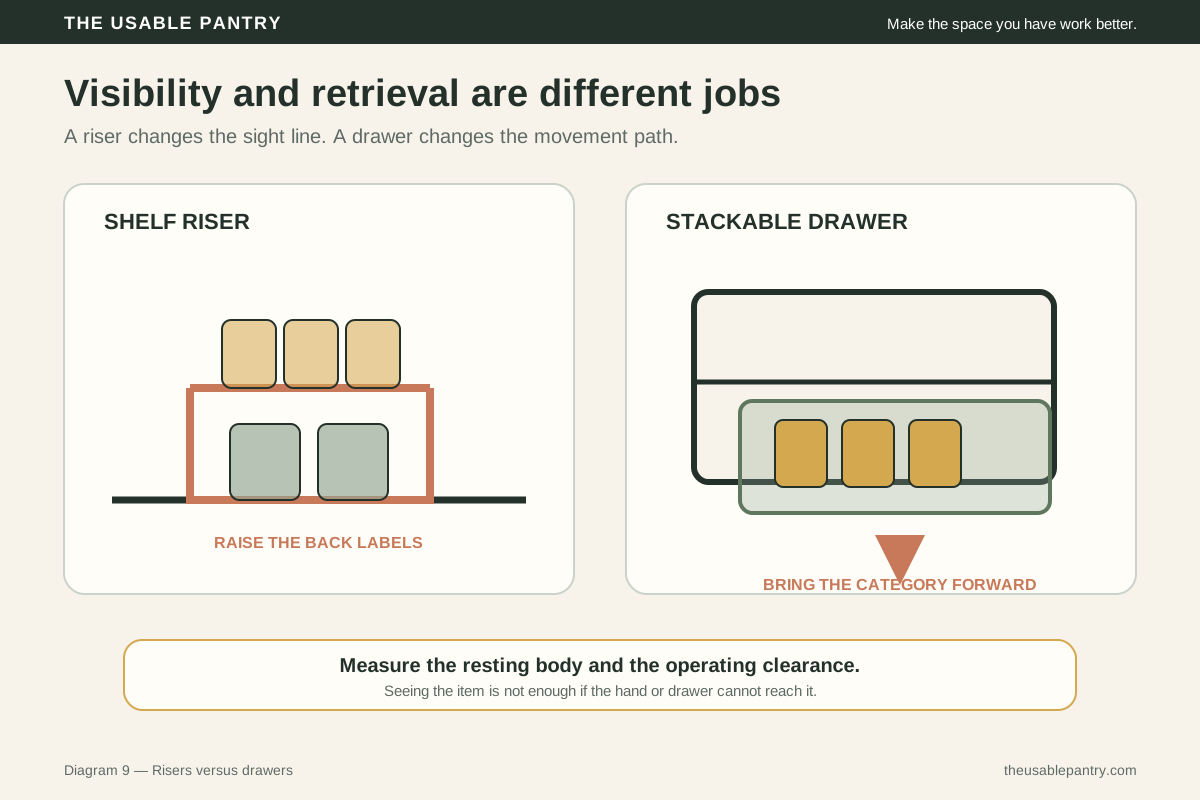
A riser does not bring a package forward. A drawer does not automatically make every item inside visible. Name the failed movement first.
 Open diagram full size
 What a shelf riser does
A freestanding riser creates an elevated surface. It can expose the labels of a short back row or divide tall and short package heights.
It works best when:
- elevated items remain within a controllable reach;
- the front row does not block the user's hand;
- the riser feet sit fully on a suitable surface;
- the combined product and item height fits below the shelf above; and
- the user can remove back items without dismantling the front.
It fails when the user can see a back item but still cannot reach it, when the riser reduces needed operating height, or when the load and support are not appropriate for the product and shelf.
What a stackable drawer does
A drawer keeps a category inside a moving compartment. The user pulls the contents toward the aisle while the unit above stays in place—when the product is designed, assembled, loaded, and supported for that use.
It works best when:
- the category benefits from contained pull-forward access;
- the drawer can open past the frame, hinge, or shelf lip;
- the handle and hand remain accessible;
- stacked units fit and connect as the manufacturer intends; and
- the loaded drawer remains controllable.
It fails when the opening is narrower than the resting shelf, the drawer needs more forward space than the door allows, tall packages catch, or the stack encourages heavy categories to move at an awkward position.
Measure operation, not only the product body
Record:
- narrowest opening width;
- usable shelf width and depth;
- smallest clear height;
- shelf lip, hinge, and door clearance;
- the product's greatest exterior dimensions; and
- the extra path needed to lift a back item or open a drawer.
For a riser, add the riser height, item height, and removal allowance. For a drawer, check the body while closed and the path while open. A listing dimension may describe the closed product without explaining every operating movement.
Choose by the access failure
| What you observe | Riser test | Drawer test | Better first question |
|---|---|---|---|
| Short cans vanish behind short cans | Raise one stable back row | May add unnecessary containment | Can the raised row still be reached? |
| Flexible packets spread across depth | Elevation may not control them | One light category can pull forward | Does the loaded category move as one unit? |
| Visible jars require moving front jars | Visibility alone is insufficient | Rotation or a drawer may change access | Which movement removes the fewest unrelated items? |
| Shelf has large unused height | Use height only if it improves sight or grouping | Stack only if independent access is needed | Is unused height actually causing a problem? |
| Narrow door opening blocks wide products | A narrower riser may pass individually | Drawer body and rails must pass the opening | What is the controlling opening dimension? |
| Heavy cans would fill the organizer | Verify riser and shelf support | Loaded drawer may become difficult to pull | Can the intended user control the realistic load? |
Worked example: one shelf, two failures
Test both functions with existing materials
To test elevation, use a stable temporary platform only for a layout trial and without relying on it for unsafe loading. Check whether the raised label becomes visible and whether a hand can still reach the back item.
To test pull-forward access, place one light category in an existing box and pull it through the real opening. Notice grip, weight, door clearance, and whether neighboring items must move.
Temporary tests do not establish structural strength, product safety, or long-term stability. They reveal whether elevation or forward movement is the missing function.
Common mistakes
- Buying a riser when reach, not visibility, is the main problem.
- Buying drawers merely because empty height is available.
- Measuring the shelf but not the door opening.
- Forgetting removal space above elevated items.
- Comparing product capacity without a realistic loaded movement.
- Stacking units that are not designed for the selected configuration.
- Putting heavy contents into the least controllable reach position.
Frequently asked questions
Can I put drawers on top of a shelf riser?
Only when the products, support surface, dimensions, load, and manufacturer instructions allow the exact configuration. Combining products creates a new stability and access problem; it is not assumed safe because each item works separately.
Are risers better for cans?
They can improve the view of short cans, but weight, reach, shelf loading, and removal still matter. A visible can that is difficult to control is not an access success.
Do drawers waste space?
Walls, rails, gaps, and operating clearance use space. That tradeoff can be worthwhile when independent pull-forward access solves a real problem. Compare usable access, not only cubic volume.
What if the shelf height is adjustable?
Recalculate both affected shelf compartments, confirm the shelf's intended support positions, and test the resulting reach. Moving a shelf can solve the height mismatch without adding either product.
Methodology and evidence
Continue the comparison
Use the pantry measurement guide before evaluating either product type.
Found a riser or drawer access case this guide misses? Send a correction.